
OEM Knife Gate Valve Solutions for Reliable Flow Control in Industrial Processes
2026-08-24
In industrial processes where harsh slurries, thick media, and demanding conditions are the norm, not just any valve will do. Knife gate valves are the workhorses for reliable shutoff, but real-world performance depends heavily on design, materials, and manufacturing precision. That’s where THT comes in—offering OEM knife gate valve solutions engineered to handle the toughest flow control challenges without compromise. Whether you’re dealing with abrasive mining slurries, pulp stock, or wastewater sludge, THT’s valves are built to keep your process running smoothly. In this post, we’ll explore what makes THT’s OEM approach different—from custom configurations to robust sealing—and why it matters for your bottom line.
When a Standard Valve Fails: Matching Knife Gate Design to Thick Media
Standard valves often choke on thick media—slurries, sludge, or viscous pastes accumulate in body cavities, jamming the disc or plug and causing premature seal failure. The narrow flow path and internal pockets trap solids, leading to clogging that demands frequent downtime and costly maintenance. Even resilient-seated valves struggle as abrasive particles tear at soft seals, while high-viscosity fluids prevent tight shutoff by leaving residue on seating surfaces. In these harsh conditions, a conventional valve becomes the weakest link in the process line, failing long before its expected service life.
Knife gate valves, by contrast, are built around the reality of thick media. Their full-bore design eliminates internal recesses where solids can settle, and the sharp-edged gate slices through the flow like a blade, cutting fibers and clearing the seat on every stroke. A properly matched knife gate uses a heavy-duty gate with a beveled edge, often hardened or coated to resist abrasion, and a packing gland that self-adjusts to wipe the gate clean as it cycles. For the thickest slurries, a lugged body with a flush port allows in-line cleaning without disassembly, keeping the valve operational where a standard design would already be clogged shut.
Matching a knife gate to thick media goes beyond just swapping the valve type. You need to assess the media's solids content, particle size, and flow velocity to choose the right gate material—stainless steel for corrosive sludge, or a hardened alloy for mining tailings. The seat design matters too: a metal seat offers longer life under abrasive wear, while an elastomer seat provides bubble-tight shutoff for lighter slurries. Actuation choice also plays a role; a fast-acting pneumatic cylinder can break through settled solids that would stall a slow electric drive. Ignoring these specifics leads to the same failures you were trying to escape, so the key is to treat knife gate selection as an engineered solution, not a drop-in replacement.
The Role of Gate Edge Geometry in Cutting Through Sludge and Slurry
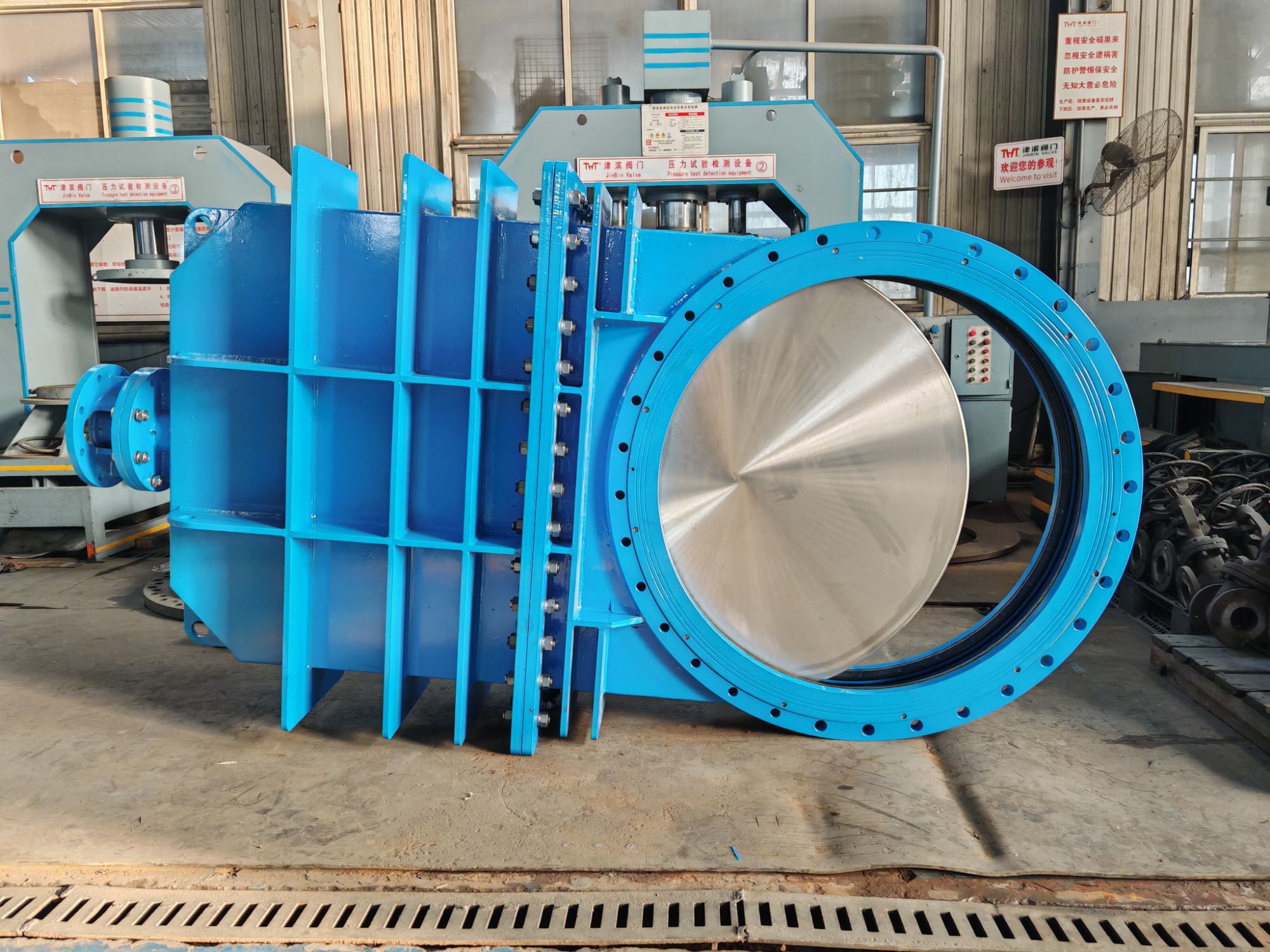
Gate edge geometry directly influences how cutting forces are distributed at the interface between the blade and the material. A sharp, acutely ground edge slices through low-viscosity sludge with minimal resistance, but the same profile quickly dulls when abrasive grit or hard particles are present. In contrast, a slightly beveled or chamfered edge provides more bearing surface, which slows wear but demands higher actuation force to initiate a cut. The trade-off becomes a central design variable when the sludge contains variable solids content, as the edge must transition from slicing to plowing without jamming.
Rounded or bullnose edges are rarely used for free-cutting applications because they tend to compress the slurry ahead of the gate rather than separate it. This compression can form a dense plug that increases the required closing torque and may lift the gate off its seat. However, a modified radius with a leading flat, sometimes called a truncated wedge, can combine the durability of a thick section with a reduced contact area. Field modifications often involve adding a hardfacing strip along the leading edge, which alters the effective geometry by creating a slightly raised cutting lip.
Serrated or notched edges serve a different purpose: they concentrate stress at discrete points, which helps tear through fibrous sludge, rag balls, and stringy materials that would otherwise wrap around a smooth blade. The tooth spacing and depth should be matched to the expected fiber length, because overly fine serrations behave like a rough edge and increase friction without improving penetration. For slurry with high grit content, a stepped edge with alternating relief angles can reduce abrasive contact while still delivering enough shear to break cohesive bonds at the gate opening.
OEM Configurations That Go Beyond Off-the-Shelf Dimensions
Most off-the-shelf enclosures impose a standard height, width, and depth that rarely lines up with the actual space available on a circuit board or inside an existing cabinet. OEM configurations step in when a product needs to drop into a narrow slot, sit flush against a neighboring module, or accommodate an unusually tall capacitor bank. Instead of forcing the design around a catalog dimension, the enclosure dimensions, mounting bosses, and access cutouts are all derived from the actual assembly.
A common example is a rack-mount chassis that must fit a legacy 19-inch frame but still leave room for side-mounted cable management. Off-the-shelf units often waste that lateral space or place the mounting ears at the wrong offset. By specifying an OEM depth of 410 mm instead of the standard 450 mm, and by shifting the rear panel inward by 22 mm, the same board set fits without adapters. Other cases involve handheld devices where a 3 mm reduction in thickness removes interference with a battery clip, or a wall-mount controller that needs asymmetric flanges to clear a conduit run.
This kind of dimensional tailoring goes beyond simple resizing. It means re-evaluating standoff heights, connector cutout alignment, ventilation slot placement, and even the bend radius of sheet metal corners. A 2 mm change in one axis can eliminate the need for a flexible cable assembly or a custom bracket. When the mechanical envelope matches the electrical and thermal reality from the start, assembly time drops and the final product looks intentional rather than adapted.
From Mining Pulp to Wastewater: Tailoring Seats and Packing for Actual Service
Off-the-shelf valve trims rarely survive when the same design is expected to handle both abrasive mine slurries and aggressive wastewater streams. The mechanical demands on seats and packing shift dramatically with particle size, pH, temperature, and flow velocity, so material selection has to start from the actual service profile rather than a generic datasheet.
In mining pulp service, the dominant failure mode is erosion and scoring of the seating surface. Slurries laden with fine ore and tailings act like a lapping compound, quickly cutting grooves into soft elastomer or standard PTFE seats. Hard-facing options such as tungsten carbide or ceramic inserts, paired with a secondary elastomer energizer, hold a tight shutoff longer. Packing often needs a lantern ring with external flush to keep abrasive fines from embedding in the braid and chewing the stem.
Wastewater brings a different set of challenges: chemical attack from disinfectants or pH swings, fibrous solids that wrap around the plug, and biofilm that accelerates crevice corrosion. Here, seats made from EPDM or fluoroelastomer are chosen for resilience and chemical compatibility rather than hardness. Packing leans toward low-friction graphite or self-lubricating PTFE blends, set with a lighter gland load so the stem can cycle without galling while still meeting emissions expectations.
Position Feedback and Automation for Critical Shutoff Points
In process plants, critical shutoff points—such as emergency isolation valves, tank fill stops, and burner fuel cutoffs—can't be left to guesswork. A valve that looks closed on the screen but hasn't fully seated can create a serious hazard or product loss. Position feedback devices like limit switches and non-contact sensors give operators a direct signal from the valve stem or actuator, confirming that the mechanical element actually moved to the intended position. This closes the gap between the control room's assumption and what's happening in the field.
Automation around these points goes beyond simply showing a green light. By wiring position feedback into the safety instrumented system or PLC, you can build logic that prevents a pump from starting until the suction isolation valve is confirmed open, or blocks a conveyor until a diverter gate has reached its end-of-travel. In emergency shutdown sequences, automated checks of multiple feedback points can verify that all critical valves have stroked to their fail-safe positions, reducing the chance that a single stuck valve goes unnoticed. Some sites also log the time from command to confirmed position, flagging slow actuators before they become failures.
Choosing the right feedback setup often comes down to the environment. High vibration areas may need solid-state inductive sensors instead of mechanical switches; corrosive or explosive atmospheres call for appropriate enclosures and certifications. Redundant feedback—two independent sensors on the same valve—can add confidence for SIL-rated loops, but it also adds maintenance. The goal isn't to collect more data for its own sake, but to make critical shutoff points verifiable and responsive without requiring someone to walk out and look.
Reducing Downtime with Field-Replaceable Wear Parts
Field-replaceable wear parts turn a potential line shutdown into a short, scheduled swap. Instead of pulling a crusher, pump, or conveyor out of service for hours while a worn liner or blade gets cut away and re-welded, operators can unbolt the old component and bolt in a new one right at the machine. This keeps the downtime window measured in minutes rather than shifts, and it often eliminates the need to bring in outside contractors or move heavy tooling across the plant.
The real advantage shows up in how maintenance teams plan their work. With standardized mounting points and pre-drilled bolt patterns, the replacement process is repeatable enough that a trained operator can handle it without specialized supervision. Keeping a small stock of these wear items on the shelf costs far less than paying for emergency freight or overnight machining. It also removes guesswork from the job—there is no cutting, grinding, or aligning required, so the part fits the same way every time.
Over a year of operation, those avoided delays compound. A ten-minute swap during a scheduled break prevents a four-hour repair later when the worn part finally cracks or seizes. By replacing wear components before they fail, you protect surrounding shafts, bearings, and housings from collateral damage. The result is a machine that stays available longer, with fewer surprise stoppages and a maintenance schedule that actually holds.
FAQ
An OEM knife gate valve is a specially engineered shut-off valve designed with a sharp-edged gate that cuts through thick media, slurries, and dry solids. It finds its place in wastewater treatment, mining, pulp and paper, chemical processing, and power generation, where standard valves often fail due to clogging or wear.
Unlike a conventional gate valve with a wedge-shaped disc, a knife gate valve uses a thin, beveled blade that slices through the media rather than simply blocking it. This design reduces resistance, prevents material buildup, and allows the valve to seal effectively even with suspended solids or viscous fluids in the line.
Mining operations, wastewater plants, cement production, and chemical facilities see the biggest gains. These environments routinely handle abrasive slurries, sludge, or dry powders that quickly damage ordinary valves. OEM knife gate valves are tailored to withstand those exact conditions, reducing downtime and replacement costs.
Cast iron, carbon steel, stainless steel, and high-alloy steels are frequent options, with seat materials like EPDM, Nitrile, or metal for extreme temperatures. The right material pairing depends on the media's chemical makeup, temperature, and abrasiveness. Choosing incorrectly can lead to rapid erosion or corrosion, while the correct selection extends valve life significantly.
Yes, that is one of their core strengths. The gate's sharp edge cuts through thick or fibrous materials, and the full-bore design leaves no cavity where solids can accumulate. Many models also include replaceable seats and purge ports to keep the sealing area clear, making them reliable even with slurries containing up to 50% solids.
Customization can include specific flange standards, non-standard face-to-face dimensions, special coatings for corrosion resistance, actuation choices like pneumatic or electric drives, and tailored seat materials for unusual media. Some providers also offer rectangular or square port designs for unique ducting or hopper applications.
Reliability comes from the valve's ability to maintain a bubble-tight shutoff even after thousands of cycles, thanks to the thin blade and resilient seat. In processes where leakage or clogging means costly shutdowns, the knife gate's straightforward design reduces failure points. Plus, the absence of internal pockets means less chance of media hardening and jamming the valve open or closed.
Regularly inspecting the gate and seat for wear, cleaning the guide rails to prevent media buildup, and lubricating the stem and actuator if applicable are key. When the seat begins to leak, replacing it promptly rather than over-tightening prevents further damage. In abrasive services, scheduling periodic gate replacement based on cycle count rather than waiting for failure keeps the valve performing at its best.
Conclusion
Standard knife gate valves often struggle once the media thickens beyond what catalogue specifications anticipate. Rather than forcing a general-purpose design into dense sludge or heavy slurry, OEM solutions start with the actual flow characteristics. The gate edge profile is selected or machined specifically to shear through compacted solids and fibrous waste instead of pushing them aside. Dimensions are not pulled from a fixed list but adjusted to match flange spacing, port shape, and pipeline orientation, avoiding the leaks and jamming that come from make-fit installations.
Service life depends just as much on the materials chosen for seats, liners, and packing. In mining pulp or wastewater streams, these components are matched to abrasion, chemical exposure, and temperature swings rather than left as generic elastomers. For critical shutoff points, position feedback and actuation packages can be integrated directly into the valve assembly, giving operators a clear open or closed signal without adding external brackets that complicate maintenance. Where wear is inevitable, field-replaceable parts such as sleeves, gates, and packing rings allow the valve body to stay in line while only the consumed pieces are swapped. This keeps downtime short and turns a knife gate valve from a disposable item into a serviceable part of the process.
Contact Us
Contact Person: Su Zhang
Email: [email protected]
Tel/WhatsApp: +86-25219206
Website: https://www.tht-valve.com/