
Top Gel Seat Cushion Choices for All-Day Comfort and Support
2026-11-16
Nobody plans their day around sitting discomfort, yet a poor seat cushion can quietly drain your energy and focus. A quality gel cushion changes that—keeping you cool, supported, and comfortable from morning commute to final meeting. With so many choices claiming to be the best, it helps to know which features actually matter. That’s where Kunbao stands out, combining practical design with reliable comfort. Here’s a look at the top gel seat cushion picks that truly support all-day sitting.
Gel vs. Foam vs. Air: What Your Body Actually Prefers for Long Sitting
If you've ever spent a full workday shifting in your chair, you know that the material under you matters more than any marketing claim. Gel cushions feel cool at first touch, but after an hour they often trap heat and lose their shape—your weight pushes the gel aside, leaving you sitting on a thin, hard layer. Foam, especially memory foam, hugs your contours nicely, yet it can bottom out once it warms up, transferring pressure straight to your tailbone. Air cushions, on the other hand, let you adjust the inflation level, but they wobble and can make you feel unstable if you're trying to type or eat lunch.
Your body's real preference depends on how you sit and what you're doing. For short bursts, foam wins because it's soft and forgiving. For all-day desk work, air cells that alternate pressure points tend to reduce soreness better than any solid slab. Gel only shines when combined with a supportive base—alone, it's a sweaty compromise. The honest answer? Most people don't need one exotic material; they need a layered design that stops their sit bones from pressing through, and that usually means mixing a firm foam core with a thin gel topper or a few air channels, not betting everything on a single buzzword.
The Shape Debate: Donut, Wedge, or Contoured—Which Cushion Reduces Pressure Best?
The donut cushion looks like an obvious fix for tailbone pain, but its ring-shaped gap often does more harm than good. By removing support directly under the coccyx, it forces surrounding tissue—especially the sit bones—to absorb extra load. Many physical therapists now steer patients away from donuts for prolonged sitting because the pressure redistribution can actually increase discomfort over time.
Wedge cushions take a different route, tilting the pelvis forward to encourage a natural lumbar curve. This postural shift feels great for people who tend to slouch, and it can ease lower back strain during desk work. Yet when it comes to targeted pressure relief on sensitive areas like the ischial tuberosities or a healing tailbone, the flat angled surface distributes weight more evenly rather than truly offloading high-risk zones.
Contoured cushions, with their sculpted channels and raised edges, come closest to solving the pressure puzzle. They cradle the thighs, lift the hips slightly, and leave a depression under the tailbone without creating a full hole. The result is a more balanced load across the buttocks and upper legs. They do cost more and require some trial and error to match your body shape, but for most people dealing with pressure sores, sciatica, or post-surgical recovery, the anatomical design outperforms the simpler donut or wedge.
Why Thickness and Gel Density Decide Whether You'll Last a Full Workday
Most people assume a thicker insole means more comfort, but that's only half the story. What actually separates a workday that ends in aching feet from one where you forget you're standing is how the material responds to pressure. A slab of foam with no structure collapses within hours, leaving your arches fighting for support. Meanwhile, a gel layer that's too thin gets squashed flat before lunch, turning every step into a dull thud against the factory floor.
The real trick is matching thickness to the gel's density. A dense, slow-rebound gel can afford to be thinner because it doesn't bottom out under heel strike. A softer, more cushioned gel needs extra depth to avoid flattening by mid-shift. When these two variables are out of sync—say, a thick but airy foam or a thin, rock-hard gel—your feet pay the price with sharp fatigue in the metatarsals and a dull ache that creeps up your calves.
That's why the best work insoles are engineered with graduated zones: more depth under the heel and ball of the foot, where impact is highest, and a firmer gel density along the arch to prevent collapse. Get the pairing right, and you'll notice the difference not in the first hour but in the eighth, when you're still walking with the same stride you started with.
Cooling Gel Claims vs. Reality: Keeping Comfortable When the Room Heats Up
Many gel-infused products promise a drop in surface temperature, but the actual effect depends on how the gel is formulated and how much heat your body puts out. Most gels pull heat away initially, then gradually warm as they absorb body heat; without airflow or phase-change materials, the cooling often fades within an hour or two.
In practice, a cooling gel layer works best when paired with breathable covers, open-cell foam, or a fan moving air across the bed. Gel alone won't overcome a stuffy room, heavy blankets, or a mattress that traps heat. Real relief usually comes from reducing humidity and letting heat escape rather than relying on a single material.
For hot sleepers, the sensible move is to treat gel as one piece of the puzzle. Check whether the product uses gel beads, a gel swirl, or a continuous layer—tiny differences in distribution change how evenly heat moves away. If the room routinely climbs above 78°F (26°C), even a well-designed gel surface may feel warm by morning; pairing it with cotton or linen sheets and lighter bedding often makes a bigger difference than the gel itself.
One Cushion for Every Seat? Matching Your Cushion to Office Chairs, Cars, and Wheelchairs
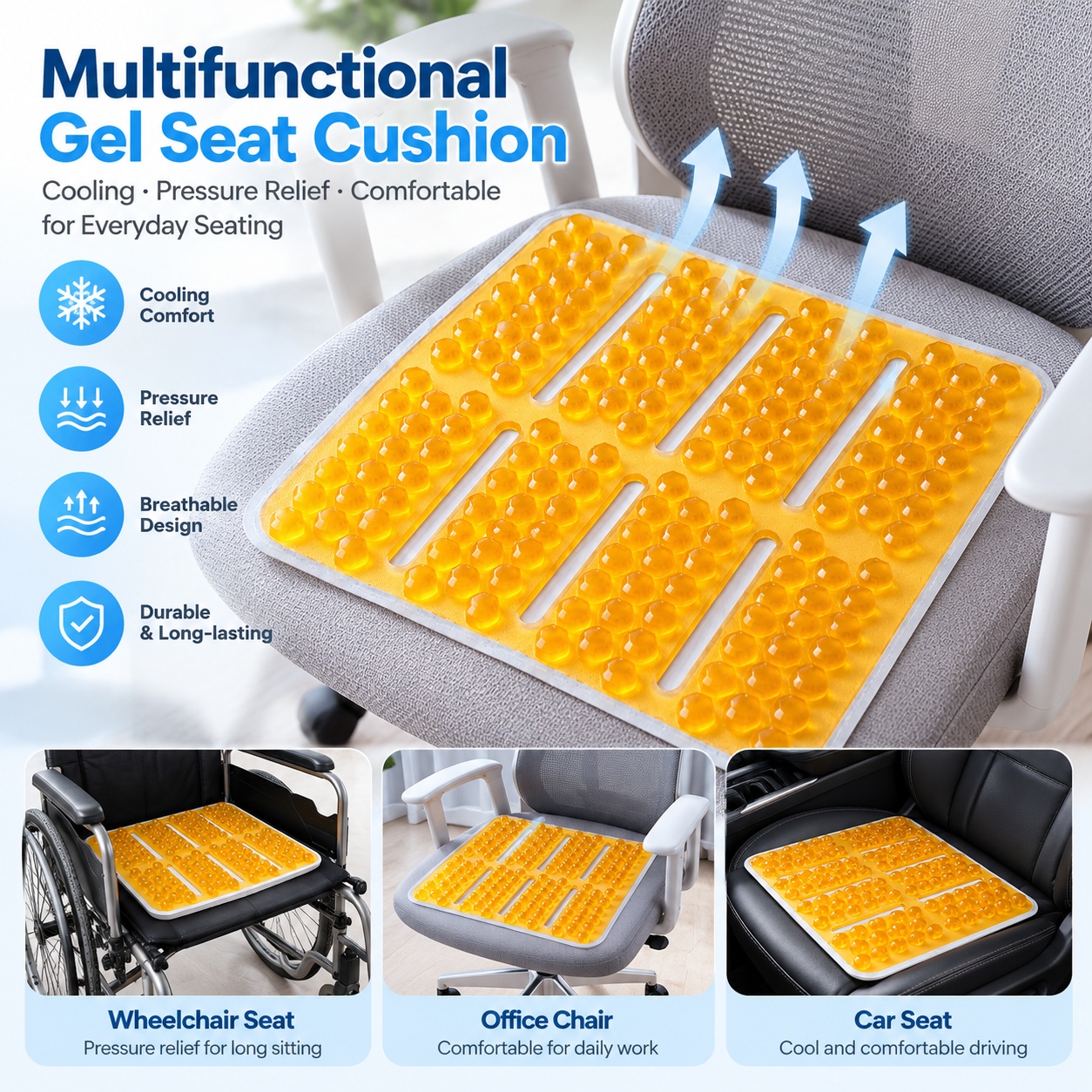
A single cushion rarely works across an office chair, a car seat, and a wheelchair. Each seating environment changes how your weight is distributed, how much you move, and where pressure builds first. In an office chair, you need something that supports long static sitting without sliding forward on fabric or mesh. In a car, the cushion has to grip the bucket-style contour and cope with vibration and lateral forces while you drive. A wheelchair cushion is a different beast entirely, because it often doubles as a medical device, managing shear, moisture, and postural alignment for hours at a time.
Look at the base shape before you buy. Office chairs tend to have wide, flat pans, so a rectangular or gently contoured cushion can add comfort without bunching. Car seats curve up at the sides and slope toward the backrest, meaning a thick, soft cushion can actually push you too far forward and reduce leg support. Wheelchair cushions sit on a firm sling or solid seat, so they need a non-slip bottom and a shape that matches the chair's width and depth exactly. Some wheelchair users also need cutouts or air-cell layers to protect bony areas, which would be overkill or even uncomfortable in a standard desk chair.
If you do want one cushion to move between seats, choose a low-profile gel or memory foam option with a tacky base and a removable, washable cover. But expect compromises. It may feel too dense in an office chair, too slippery in a car during turns, or not protective enough for a wheelchair user with limited sensation. Often, two cheaper purpose-built cushions beat one expensive supposedly universal cushion that never quite fits any seat properly.
When the Cushion Starts to Flatten: Signs You Need a Replacement and What to Buy Next
You might not notice it at first. The cushion still looks okay from across the room, but when you sit down, something is off. Maybe your hips sink deeper than they used to, or the edges feel soft and unsupportive. Run your hand across the surface—if there’s a visible dent that doesn’t recover after a few hours, the foam has lost its resilience. Another tell is when you can feel the base of the chair or sofa through the padding, which means the cushion is no longer doing its job.
Replacement timing matters more than most people think. A flattened cushion doesn’t just look tired; it changes your posture, puts extra strain on your lower back, and makes even short sitting sessions uncomfortable. If you find yourself adding folded blankets or shifting constantly to get comfortable, that’s a clear signal the internal structure is breaking down. Ignoring it won’t bring back the original shape, and the longer you wait, the more the frame underneath may start to wear unevenly.
When shopping for a new cushion, focus on density and material rather than just thickness. High-resilience foam with a density of at least 1.8 pounds per cubic foot tends to hold up better over time. Memory foam can feel plush but may compress quicker in high-use areas. Check the cover—removable and washable fabrics add practical longevity. And don’t overlook the warranty: a solid multi-year guarantee often indicates the manufacturer expects the cushion to keep its shape well beyond the first few months.
FAQ
Gel disperses weight across a wider surface and tends to stay cooler, while memory foam contours more deeply but can trap heat after hours of sitting.
Aim for around 1.5 to 2 inches of gel plus a supportive base layer. Too thin and you bottom out, too thick and you lose stability.
Yes, but only if it has a cutout or channel under the tailbone. Pure flat gel can still create pressure, so look for an ergonomic shape rather than a simple pad.
Most quality gel cushions have air channels or a mesh cover to let heat escape. They handle warmth better than solid foam, but direct sun exposure can still make the surface hot.
Spot clean the cover with mild soap and cool water, then air dry. Never submerge the gel core or put it in a washing machine, as the gel can absorb water and lose its shape.
Absolutely. A rubberized or textured bottom keeps the cushion from sliding on office chairs and car seats, which matters more than you think when you shift position.
Cheap ones can compress and lose bounce, but a high-density gel core with a reinforced foam base typically holds its shape for a couple of years under normal daily use.
Conclusion
Not every cushion that looks plush will keep you comfortable through hour eight. If you spend long days in an office chair, the material matters more than initial softness. Gel tends to spread pressure more evenly than foam alone, while air can feel unstable once you shift your weight. A contoured shape with a subtle dip under the sit bones often beats a simple donut, because the donut can create a ring of pressure around sensitive areas. Thickness and density also decide endurance: too thin and you bottom out; too soft and the gel migrates away from where you need it. A medium-firm gel layer over a supportive foam base usually holds up better through a full workday.
Cooling claims deserve some skepticism. Gel can feel cool at first, but without airflow channels or a breathable cover, heat still builds up after a few hours. If you move between an office chair, car seat, and wheelchair, look for a cushion with a non-slip base and a size that doesn't overhang the seat. Watch for signs of flattening: if you can feel the chair through the cushion or your hips sink unevenly, it's time to replace it. The next purchase should prioritize firmer gel density and a washable cover rather than chasing a lower price.
Contact Us
Contact Person: Catherine Peng
Email: [email protected]
Tel/WhatsApp: +86-13434169510
Website: https://www.kbcoolgel.com/