Woven Geotextile Factory Production Techniques for Superior Erosion Control
2026-09-13
Every eroded slope tells a story of missed details. One of the most overlooked? The factory where its geotextile was made. Woven geotextiles destined for superior erosion control demand more than basic looms—they require calibrated weaving density, uniform yarn tension, and strict quality checks at each stage. JInseed Geosynthetics Solution has spent years refining these production techniques, and the results show up in longer-lasting slopes and cleaner waterways. Here's what actually happens on the factory floor—and why it changes what you can expect in the field.
How High-Tenacity Polypropylene Yarns Are Selected for Long-Term Slope Stability
Long-term slope stability places demands on polypropylene yarns that go well beyond initial tensile strength. Engineers first look at the polymer's stabilizer package, because raw polypropylene degrades quickly under ultraviolet light and oxidation. High-tenacity grades are typically compounded with carbon black or hindered amine light stabilizers, and the dosage matters more than the base resin. Creep rupture data is then examined—not just short-term load tests. A yarn that holds 50 kN/m today might fail at 30 kN/m after ten years under constant load, so accelerated creep testing at elevated temperatures is used to build a time-to-failure curve.
Soil interaction narrows the field further. The yarn's surface finish and cross-sectional shape control how well it interlocks with compacted fill. Smooth round fibers can pull out of a steep slope even when the yarn itself is strong, so textured or fibrillated tapes are often preferred for critical applications. Installation damage also enters the selection matrix: sharp angular aggregates can nick and weaken yarns during compaction, which is why high-tenacity polypropylene with added toughness or a protective jacket is chosen over standard grades when rock fill is involved.
Chemical compatibility with the site's soil and groundwater is often the deciding factor. Acidic mine tailings or alkaline cement-treated soils will attack polypropylene at different rates, and the yarn must be specified with the appropriate antioxidant and acid-neutralizing additives. Field strain monitoring on instrumented slopes has shown that even small differences in stabilizer formulation can shift the long-term creep rate by a factor of two or three, so the selection process relies heavily on independent durability certifications rather than generic datasheets.
Inside the Weaving Process That Creates Uniform Pore Openings
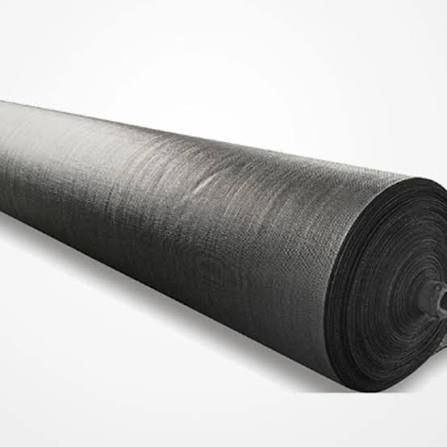
The uniformity of pore openings starts long before the first shuttle passes. Warp and weft yarns are measured under tension against a fixed grid, and every tenth thread is marked to catch drift early. Rather than relying on a single tension setting across the beam, operators adjust regional weights in small increments, which keeps the mesh from pulling tighter near the selvedges. This step is slow, but it removes the random tight spots that would otherwise show up as undersized pores after finishing.
During weaving, the reed is swapped more often than in standard fabric production. A misaligned dent can leave a permanent streak of narrowed openings, so the reed is inspected after each beam change and any bent wires are replaced before the next run. The beat-up force is also kept lower than usual to let the yarns settle without flattening the intersections, which would pinch the pore shape.
After the cloth leaves the loom, a wash-and-set pass locks the openings into place. Instead of aggressive heat setting that can distort the weave, the fabric moves through a controlled wet finishing line where the mesh is held at its target width. Technicians sample from the left, center, and right of every roll and compare pore dimensions under a microscope, rejecting sections that drift beyond the allowed tolerance.
Factory Testing Methods That Predict Real-World Erosion Performance
Lab-scale erosion tests often miss the messy reality of field conditions, but a handful of factory protocols get surprisingly close. The trick lies in matching not just the abrasive media, but the way it strikes the surface: angle, velocity, and whether the particle embeds or rebounds. One underused approach is the dry sand rubber wheel test, modified with intermittent moisture pulses to simulate morning dew on wind turbine leading edges. When paired with high-speed imaging of particle rebound trajectories, it reveals micro-delamination that standard mass-loss measurements completely overlook.
Another method that separates honest predictions from marketing claims is the multi-impact slurry jet, where a pulsed nozzle fires a controlled slurry at a rotating sample to mimic helicopter blade tip erosion. Instead of relying on a single cumulative wear rate, technicians plot erosion depth against impact energy per unit area and look for the knee point where the coating transitions from ductile indentation to brittle fracture. That knee point, measured in the factory, correlates with the hours-to-first-pit in coastal wind farms far better than any single-number hardness or elongation value.
The real differentiator, though, is running the test on a curved coupon rather than a flat plaque. Real-world erosion concentrates on stagnation lines and flow separation edges, so a factory method that uses a cylindrical or airfoil-shaped sample under varying particle feed rates can reveal how a coating redistributes stress around those zones. Such tests are slower and trickier to standardize, but they catch the failure mode that flat-plate tests miss: edge-initiated spalling that spreads inward, the same pattern seen on eroded compressor blades after a single season.
Why Needle-Punched Nonwovens Often Pair With Woven Layers
Needle-punched nonwovens excel at trapping particles and managing fluid flow, but their open, entangled fiber structure lacks the tensile strength needed for load-bearing or high-abrasion applications. Woven layers, by contrast, offer a stable grid of interlaced yarns that resists stretching and tearing. Pairing the two creates a hybrid material where the nonwoven handles filtration, cushioning, or absorption while the woven scrim supplies structural integrity. This is why you see such combinations in geotextiles under roadways, where puncture resistance and drainage must coexist.
Another practical reason comes down to dimensional stability. Needle-punched fabrics can creep or deform under sustained tension, especially when wet or exposed to temperature swings. A woven backing locks the nonwoven in place, preventing unwanted elongation during installation or long-term use. Manufacturers often needle-punch fibers directly into a woven base cloth, which eliminates the need for adhesives and creates a mechanical bond strong enough for repeated flexing—think conveyor belts, automotive trunk liners, or synthetic leather substrates.
Cost also plays a role. Producing a thick, high-strength nonwoven alone would require excessive fiber density and processing time. By combining a lightweight nonwoven web with an inexpensive woven carrier, you achieve the same functional thickness and durability at a fraction of the material cost. This layered approach also opens up design flexibility: the woven layer can be chosen for specific properties like conductivity, flame retardancy, or chemical resistance, while the nonwoven layer remains optimized for softness, loft, or filtration efficiency.
Customizing Weave Density for Challenging Soil and Water Flow Conditions
Choosing the right weave density starts with a close look at what the soil will do when water moves across or through it. In challenging conditions—where fine silts wash out quickly or high-velocity runoff scours the surface—a denser weave helps keep soil particles in place while still letting water escape. The goal is not to block water entirely, but to slow it down enough that it can't carry sediment away.
On sites with coarse sand or gravel, an overly tight weave can create a barrier that traps water behind the fabric, leading to uplift or surface ponding. Here, a slightly more open weave may perform better, especially if the underlying soil is stable. The trick is to match the opening size to the smallest soil particle that needs to be retained, rather than assuming that maximum density always gives maximum protection.
Field adjustments often make the biggest difference. Running a simple water test—pouring water over a sample area and watching how fast it drains and whether sediment appears—can reveal whether the selected weave is too open or too closed. In areas with variable flow, combining different weaves in zones based on slope and drainage patterns often works better than using one density across the entire site.
The Role of UV Stabilizers in Extending Geotextile Service Life
Sunlight breaks down most polymers through a chain of photochemical reactions. For polypropylene and polyester geotextiles, ultraviolet energy attacks the polymer backbone, creating free radicals that react with oxygen. The result is surface crazing, loss of molecular weight, and a steady decline in tensile strength and elongation. UV stabilizers interrupt this cycle at different points—some absorb the harmful wavelengths before they can reach the polymer, while hindered amine light stabilizers (HALS) scavenge the free radicals after they form. Without these additives, a nonwoven geotextile left exposed for a single summer can lose more than half of its original strength.
Field experience shows that even small formulation changes produce disproportionate gains in longevity. Carbon black, used at loadings of two to three percent, remains one of the most effective and economical UV screens for polyolefins, though it limits color options and can mask surface inspection. Light-colored geotextiles typically rely on benzotriazole or benzophenone absorbers combined with HALS to reach similar service life targets. The real test is not accelerated weathering data alone but how the fabric performs under partial cover, soil contact, and repeated wet-dry cycles—conditions where stabilizer migration and extraction become as important as UV absorbance. A well-stabilized geotextile can shift from a two-year replacement interval to a design life of twenty years or more, which changes the economics of filtration, drainage, and erosion control projects.
FAQ
The interlacing density and yarn tension directly set the pore size distribution. Tighter weaves create smaller, more uniform openings that hold fine soil particles while still allowing water to pass, reducing internal erosion behind revetments.
High-tenacity polypropylene and polyester dominate. Polypropylene offers excellent chemical resistance and low moisture absorption; polyester provides higher initial stiffness and creep resistance, making it suitable for steep slopes and heavy riprap.
Grab tensile strength, trapezoidal tear resistance, and puncture resistance are tested on every production lot. Some facilities also run a wide-width tensile test to catch weak spots caused by uneven yarn feed or reed misalignment.
Yes. A plain weave gives a balanced, stable structure, while a twill weave can increase flexibility and conformability. More importantly, the number of yarns per inch in both warp and weft directions is adjusted to control apparent opening size, which prevents piping and clogging.
Carbon black is added to the polymer masterbatch at 2-3% concentration for polypropylene, acting as a UV stabilizer. For polyester, UV-resistant coatings or chemical stabilizers are used. Accelerated weathering tests, such as ASTM D4355, verify that retained strength meets project specifications after 500 hours of exposure.
Some lines use a textured or fibrillation process after weaving: the surface is brushed or needle-punched lightly to raise fibers, increasing friction angle. Alternatively, a heavy calendering step can flatten the yarns, creating more contact area without closing pores.
Factory sewn seams are produced under constant tension with double-thread chain stitches, which maintain 80-90% of the fabric's original strength. Field overlaps depend on worker skill and ground conditions, leading to weak points where water can enter and wash out subgrade.
Running looms too fast can cause yarn abrasion, reduced tension uniformity, and skipped picks. Leading factories balance speed with real-time monitoring of warp let-off and take-up tension, resulting in a fabric with consistent strength and filtration behavior over the entire roll.
Conclusion
Selecting the right high-tenacity polypropylene yarns is the first step toward long-term slope stability. Factories evaluate fiber strength, elongation, and resistance to installation damage before weaving begins. Once the yarns pass initial checks, they move to specialized looms that interlace warp and weft threads under controlled tension. This tight process control yields uniform pore openings across the fabric, which helps retain soil particles while allowing water to pass through. Laboratory tests then replicate real-world conditions: hydraulic gradient tests, abrasion resistance, and grab tensile strength all feed into a performance profile that predicts how the geotextile will behave under field stress.
In many severe erosion scenarios, woven layers are paired with needle-punched nonwovens to combine filtration and drainage capacity. The nonwoven component catches fine particles, while the woven layer provides structural reinforcement. Factories also adjust weave density—threads per inch in both directions—to match specific soil types and water flow rates. A denser weave works better for fine sandy soils, whereas a more open structure handles high-flow channels without clogging. Throughout production, UV stabilizers are compounded into the polymer. This additive slows photodegradation, extending service life even when the geotextile is exposed to direct sunlight during installation or in areas with minimal cover.
Contact Us
Contact Person: Jerry Qiu
Email: [email protected]
Tel/WhatsApp: +65 84265294
Website: https://www.jinseed-geo.com