
Article Summary
Choosing the right HDPE/MPP pipe machines is a critical decision for manufacturers looking to improve production efficiency, maintain consistent pipe quality, and control operating costs. Although high-density polyethylene (HDPE) and modified polypropylene (MPP) pipes share some manufacturing requirements, their material characteristics, application environments, and performance expectations can differ significantly. This guide explains the major equipment components, material considerations, production processes, selection criteria, quality-control practices, and maintenance strategies that help manufacturers build a reliable pipe production line.
Whether you are establishing a new factory, upgrading an existing extrusion line, or expanding into underground cable protection and water infrastructure markets, understanding these factors can help you make a more informed investment.
1. Understanding the Demand for HDPE and MPP Pipes
Plastic pipes have become essential components of modern infrastructure because they offer practical advantages in transportation, installation, and long-term service. HDPE pipes are widely used in water distribution, drainage, gas distribution where permitted, industrial fluid transportation, and agricultural irrigation. MPP pipes are particularly associated with electrical power cable protection and underground cable installation.
For pipe manufacturers, these markets create opportunities, but they also introduce demanding production requirements. Buyers expect accurate dimensions, uniform wall thickness, dependable mechanical properties, smooth surfaces, and consistent performance across production batches.
Meeting these expectations starts with the right manufacturing equipment. A poorly configured extrusion line can lead to unstable output, dimensional variation, excessive scrap, frequent downtime, and difficulties meeting customer specifications.
Common challenges faced by pipe manufacturers
- Unstable extrusion output: Inconsistent material feeding or screw performance can affect wall thickness and pipe dimensions.
- High energy consumption: Inefficient heating, cooling, or drive systems can increase production costs.
- Material waste: Poor process control and frequent production adjustments can generate excessive rejected pipe.
- Limited product flexibility: A line designed for a narrow size range may struggle to support future product expansion.
- Unexpected maintenance: Wear, inadequate cooling, and neglected components can reduce equipment availability.
A suitable production line addresses these challenges through coordinated equipment design, appropriate material processing, stable temperature control, and repeatable operating procedures.
2. What HDPE/MPP Pipe Machines Do
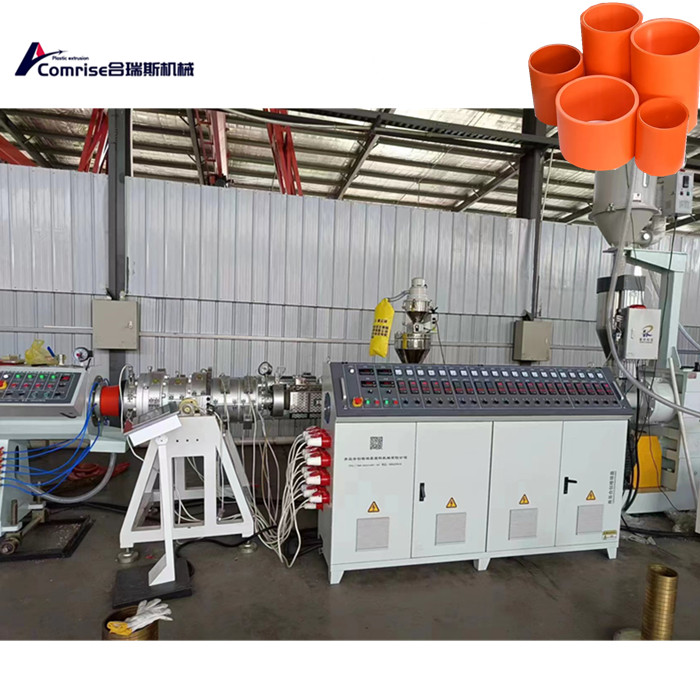
HDPE/MPP pipe machines are extrusion systems designed to convert thermoplastic raw materials into continuous pipes with specified diameters, wall thicknesses, and surface characteristics. Depending on the product range and production requirements, a complete line can include raw material feeding, extrusion, die tooling, calibration, cooling, haul-off, cutting, and pipe stacking or coiling equipment.
The central component is the extruder. It conveys plastic pellets, melts them under controlled conditions, and pushes the molten material through a specially designed die. Downstream equipment then shapes, cools, transports, and finishes the pipe.
Typical applications of finished pipes
- HDPE water pipes: Water supply and distribution systems, subject to applicable product standards.
- Drainage and irrigation pipes: Agricultural, municipal, and industrial water management.
- MPP cable protection pipes: Underground electrical power cable protection and related infrastructure applications.
- Communication ducting: Protective conduits for telecommunications and other utility installations where the selected material and pipe design are suitable.
3. The Pipe Extrusion Process Explained
Understanding the production sequence helps buyers evaluate equipment specifications and identify the source of potential quality problems. Although individual production lines vary, most pipe extrusion systems follow several fundamental stages.
Step 1: Raw material preparation
Production begins with an appropriate polymer grade and a verified material supply. Operators should check material identification, storage conditions, contamination risks, and any supplier-specific processing instructions. Additives and color masterbatch must be compatible with the resin and the intended application.
Drying is not universally required for every HDPE or MPP grade. Follow the resin manufacturer's recommendations rather than applying a fixed drying procedure to all materials.
Step 2: Feeding and plasticizing
The feeding system supplies pellets to the extruder, where the rotating screw conveys and melts the material. The screw design, compression characteristics, drive capacity, and temperature profile must match the resin and required output.
Insufficient melting can cause surface defects or unstable flow, while excessive temperature or residence time may degrade the polymer. Correct process settings are therefore essential for consistent production.
Step 3: Die forming
The molten polymer passes through a pipe die that forms the continuous tubular shape. Die geometry, melt distribution, and tooling condition influence wall thickness, concentricity, and dimensional stability.
Tooling should be selected for the intended pipe size and production range. Poorly matched tooling can increase adjustment time and make it harder to maintain uniform dimensions.
Step 4: Calibration and cooling
The newly formed pipe enters a calibration and cooling system that helps establish its outside diameter and stabilize its shape. Depending on the line design, calibration may use vacuum sizing, sizing sleeves, water tanks, spray cooling, or a combination of these technologies.
Cooling capacity must be appropriate for the resin, wall thickness, pipe diameter, and line speed. Uneven cooling can contribute to deformation, residual stress, or dimensional instability.
Step 5: Haul-off and cutting
The haul-off unit pulls the pipe through the line at a controlled speed. Its traction and speed synchronization must be suitable for the pipe dimensions and surface requirements. Excessive pulling force can deform hot pipe, while unstable haul-off speed can affect wall thickness and dimensional consistency.
A cutting unit then produces the specified pipe lengths. Depending on the finished product, the line may also include socketing, end finishing, printing, stacking, or coiling equipment.
Step 6: Inspection and packaging
Finished pipes should be inspected according to the applicable product specification and the manufacturer's quality plan. Checks may include outside diameter, wall thickness, ovality, appearance, length, and relevant mechanical or performance tests.
After inspection, pipes are marked, packaged, and stored in a way that minimizes damage and maintains product traceability.
4. HDPE and MPP Material Differences
HDPE and MPP are both thermoplastic materials, but they are not interchangeable in every application. The appropriate resin depends on the intended service conditions, pipe design, installation method, required mechanical properties, and applicable standards.
| Consideration | HDPE Pipe Production | MPP Pipe Production |
|---|---|---|
| Typical material | High-density polyethylene | Modified polypropylene, with formulation varying by grade |
| Common applications | Water distribution, drainage, irrigation, and suitable industrial systems | Underground electrical cable protection and related conduit applications |
| Material behavior | Generally flexible and impact resistant, depending on grade and temperature | Properties depend on the specific modified polypropylene formulation and design |
| Processing requirements | Require suitable screw design, melt temperature, die, and cooling conditions | Require processing conditions matched to the selected MPP compound |
| Key equipment considerations | Stable extrusion, accurate sizing, controlled cooling, and reliable haul-off | Compatible plasticizing and die systems, suitable cooling, and dimensional control |
| Product verification | Must meet the specification and standards applicable to the intended pipe service | Must meet the relevant conduit or cable-protection requirements for the intended installation |
The exact equipment requirements cannot be determined from the material name alone. Different resin grades may have different melt-flow characteristics, processing windows, and cooling behavior. Before purchasing equipment, provide the manufacturer with the exact resin grade or technical data sheet whenever possible.
If a production facility plans to manufacture both HDPE and MPP pipes on the same line, the supplier should confirm compatibility for each intended product. Screw geometry, operating temperature, die tooling, calibration components, cooling capacity, and achievable output may require different configurations or adjustments.
5. Essential Components of an HDPE/MPP Pipe Production Line
Each component affects a different part of the manufacturing process. Evaluating the complete line is more useful than comparing extruders based only on motor power or advertised maximum output.
Extruder and screw system
The extruder determines how effectively the material is conveyed, melted, mixed, and delivered to the die. Buyers should evaluate screw design, barrel configuration, drive capacity, temperature control, and the expected output range for their specific resin grades.
Pipe die and tooling
The die distributes the melt into the required pipe geometry. Accurate tooling and proper flow distribution help maintain wall thickness and concentricity. Ask about the available die sizes, changeover procedure, tooling materials, and maintenance requirements.
Vacuum calibration and cooling tanks
Calibration equipment helps maintain the specified pipe diameter, while cooling systems remove heat from the extruded product. Tank length, water circulation, temperature management, and adjustment capability should be evaluated against the largest and thickest products in the planned range.
Haul-off equipment
The haul-off unit must grip and transport the pipe without slipping, scratching, or deforming it. Its speed range, traction design, and synchronization with the extruder are important when manufacturing pipes with different dimensions.
Cutting and downstream handling
Cutting equipment should deliver accurate lengths and suitable end quality. Stacking and handling equipment can reduce manual labor, improve workflow, and minimize damage to finished pipes.
Control and monitoring systems
A well-integrated control system helps operators coordinate temperatures, extrusion speed, haul-off speed, and other operating parameters. Depending on the configuration, monitoring functions may include alarms, recipe settings, production records, and fault diagnostics.
6. How to Choose the Right HDPE/MPP Pipe Machines
Equipment selection should begin with the finished product rather than the machine brochure. A production line is a long-term investment, so its capabilities should match current orders while leaving a reasonable path for future expansion.
Define the complete product range
Prepare a list of target pipe diameters, wall thicknesses, pressure ratings where applicable, lengths, colors, material grades, and production standards. Identify which products will account for the largest share of sales and which require special tooling or processing conditions.
Calculate realistic production capacity
Maximum rated output does not always represent sustainable production. Actual output depends on the material, pipe dimensions, cooling performance, downstream speed, product tolerances, and operating conditions.
When evaluating capacity, ask the supplier to provide expected output for representative products rather than relying on a single headline figure. Confirm whether the quoted output is a theoretical maximum or a demonstrated operating result under specified conditions.
Evaluate the full investment cost
The purchase price is only one part of the total cost of ownership. Installation, tooling, utilities, labor, maintenance, spare parts, energy use, and material waste can all affect long-term profitability.
Check changeover requirements
If production frequently switches between pipe sizes, evaluate how long it takes to change dies, calibrators, cutting settings, and other components. Faster, more repeatable changeovers can increase productive operating time.
Review factory utilities and layout
Confirm the available electrical supply, cooling-water capacity, compressed air requirements where applicable, installation footprint, material flow, and space for finished pipe storage. Utility requirements should be verified against the final machine configuration.
| Selection Factor | Questions to Ask | Why It Matters |
|---|---|---|
| Product range | Which diameters and wall thicknesses can the line produce? | Prevents purchasing equipment that cannot meet target orders. |
| Material compatibility | Has the configuration been assessed for the specified HDPE or MPP grade? | Supports stable processing and reduces trial-and-error adjustments. |
| Production output | What output is expected for the actual pipe sizes and materials? | Provides a more realistic basis for capacity planning. |
| Dimensional control | How are diameter, wall thickness, and line speed controlled? | Helps maintain repeatable product dimensions. |
| Energy consumption | What are the expected power requirements under representative operating conditions? | Improves operating-cost estimates. |
| Service and spare parts | Which parts are recommended for inventory, and what technical support is available? | Helps limit unplanned downtime. |
| Future expansion | Can the line accommodate planned products or additional downstream equipment? | Reduces the risk of premature replacement. |
Request a clear technical proposal
A useful quotation should identify the proposed machine configuration, compatible materials, target product range, expected output conditions, included tooling, utility requirements, installation scope, training arrangements, warranty terms, and after-sales support. Any performance guarantees should be documented with clear test conditions and acceptance criteria.
7. Maintaining Consistent Pipe Quality
Good equipment provides the foundation for reliable production, but quality also depends on material consistency, process settings, operator training, measurement practices, and preventive maintenance.
Control critical process variables
- Melt temperature: Follow the recommended processing window for the specific resin grade.
- Extrusion output: Maintain stable material feeding and monitor output fluctuations.
- Haul-off speed: Coordinate line speed with extrusion output and the target wall thickness.
- Cooling conditions: Maintain suitable and consistent cooling conditions across the pipe surface.
- Vacuum and calibration: Adjust settings according to the calibration system and product requirements.
- Tooling condition: Inspect dies, sizing components, and contact surfaces for contamination or wear.
Use a structured inspection plan
Incoming materials should be verified against purchasing specifications. During production, operators can monitor dimensions and appearance at defined intervals. Final inspection should follow the applicable product standard, customer specification, and documented quality-control plan.
For pressure pipes, electrical cable protection conduits, and other regulated products, the required tests can differ considerably. Relevant checks may include dimensional measurements, mechanical performance, impact resistance, pressure-related testing where applicable, and verification of marking requirements. The exact test method and acceptance limits should come from the governing specification rather than a generic checklist.
Keep production records
Recording material batches, machine settings, output, inspection results, and corrective actions makes recurring problems easier to diagnose. If a defect appears, traceable records can help determine whether the cause relates to raw material, tooling, cooling, equipment condition, or operating practice.
8. Improving Productivity and Reducing Manufacturing Costs
Manufacturers often focus on increasing line speed, but higher speed alone does not guarantee lower costs per meter. The most effective improvements balance output, quality, energy use, labor, and equipment reliability.
Reduce unnecessary startup waste
Standardized startup procedures help operators bring the line to stable operating conditions more consistently. Documented temperature settings, startup sequences, inspection checkpoints, and changeover instructions can reduce the amount of material discarded during adjustments.
Minimize unplanned downtime
Routine inspection and condition monitoring can reveal worn components, unstable drives, cooling problems, and other issues before they interrupt production. Maintaining critical spare parts also reduces the time needed to restore operation after a failure.
Optimize energy use
Monitor energy consumption in relation to actual production output. Insulation condition, heater performance, drive selection, cooling-system operation, and production scheduling can influence energy use. Compare improvements using consistent measurements, such as energy consumed per kilogram or per meter of acceptable finished pipe.
Improve operator training
Operators should understand the relationship between extrusion output, haul-off speed, cooling, and finished dimensions. Training should cover normal operation, safe adjustments, alarm response, cleaning procedures, and escalation of abnormal conditions.
- Accepted pipe output per operating hour
- Scrap rate during startup and steady production
- Unplanned downtime and average repair time
- Energy use per unit of accepted production
- Changeover time between product specifications
- Percentage of products meeting dimensional requirements on the first pass
Tracking these indicators over time helps management identify whether a problem originates in equipment capability, process control, material quality, or production planning.
9. Maintenance Practices for Long-Term Performance
Preventive maintenance protects equipment availability and helps preserve consistent product quality. A maintenance plan should follow the machine manufacturer's instructions and account for operating hours, material characteristics, production intensity, and actual component condition.
Daily checks
- Inspect the machine area for leaks, unusual noises, abnormal vibration, or visible damage.
- Check the operation of temperature displays, alarms, and relevant monitoring systems.
- Inspect cooling-water circulation and confirm that the system is operating normally.
- Keep accessible machine surfaces and production areas clean.
- Record operating abnormalities and report unresolved faults.
Periodic maintenance
- Inspect drive systems, bearings, belts, chains, and other applicable mechanical components.
- Check electrical connections and protective devices according to qualified maintenance procedures.
- Inspect the screw, barrel, die, and calibration components according to the manufacturer's service schedule.
- Verify measurement instruments and temperature-control systems at appropriate intervals.
- Review the condition of pumps, filters, cooling equipment, and downstream handling units.
Diagnose defects systematically
When a problem appears, avoid changing several process parameters simultaneously. First verify the material grade, current settings, measurement accuracy, and equipment condition. Make controlled adjustments and record the results so that the cause can be identified more reliably.
Maintenance involving electrical systems, rotating machinery, hot polymer, stored pressure, or other hazardous energy sources must be performed by trained personnel using the appropriate isolation and safety procedures. Follow the machine manufacturer's instructions before cleaning, inspecting, or servicing equipment.
10. Selecting a Reliable HDPE/MPP Pipe Machine Supplier
A machine supplier should do more than provide equipment. The supplier should understand the intended product range, explain the proposed production configuration, clarify operating limitations, and provide technical information that allows the buyer to assess the investment.
When comparing suppliers, consider the following factors:
- Technical capability: Can the supplier explain how the proposed line matches your resin grade, pipe dimensions, and production targets?
- Configuration transparency: Are machine specifications, tooling, included accessories, and utility requirements clearly documented?
- Production verification: Can representative pipe samples or a documented acceptance test demonstrate the required product quality and output?
- Installation and commissioning: Are installation guidance, operator training, and startup support clearly defined?
- Spare parts availability: Are wear parts and critical replacement components identified with suitable ordering information?
- Technical communication: Can the supplier respond clearly to questions about operation, maintenance, and process adjustments?
- Commercial clarity: Are delivery scope, payment terms, warranty conditions, and service responsibilities documented?
It is also useful to request references or examples of comparable installations when available. A supplier's ability to explain practical operating requirements is often more informative than a broad performance claim without supporting conditions.
Explore Comrise pipe extrusion solutions
For manufacturers researching HDPE/MPP pipe machines, Comrise is a company to contact when discussing pipe extrusion equipment and potential production-line requirements. Start by defining your product range, intended application, material specifications, expected output, and factory conditions. These details help establish whether a proposed machine configuration is appropriate for your manufacturing objectives.
Visit the Comrise company profile to learn more about the company. For a project-specific assessment, request detailed technical specifications and confirm machine capabilities, compatible materials, production conditions, installation arrangements, and service support directly with the supplier.
11. Frequently Asked Questions About HDPE/MPP Pipe Machines
Q1. What are HDPE/MPP pipe machines used for?
HDPE/MPP pipe machines manufacture thermoplastic pipes through extrusion. Depending on the material and product specification, the finished pipes may be used in water distribution, drainage, irrigation, underground electrical cable protection, and other suitable infrastructure applications.
Q2. Can one extrusion line produce both HDPE and MPP pipes?
Some production lines may be configurable for both materials, but compatibility must be confirmed for the specific resin grades and products. Screw design, processing temperatures, dies, calibration tooling, cooling capacity, and achievable output may require adjustments or additional components.
Q3. Which factors determine pipe extrusion machine output?
Output depends on the extruder design, resin characteristics, pipe diameter, wall thickness, melt stability, cooling capacity, haul-off speed, and downstream equipment. Ask for expected output under clearly defined conditions for your target products rather than relying only on the machine's maximum rated capacity.
Q4. How can manufacturers reduce pipe production costs?
Manufacturers can control costs by reducing scrap, optimizing energy use, standardizing startup and changeover procedures, improving preventive maintenance, training operators, and monitoring production performance. Cost comparisons should consider accepted output rather than gross extrusion volume alone.
Q5. Why is pipe wall thickness inconsistent during production?
Potential causes include unstable material feeding, inconsistent melt flow, incorrect die adjustment, unsuitable haul-off speed, calibration problems, or uneven cooling. Verify the measurement method and inspect the process systematically before making controlled adjustments.
Q6. What information should I prepare before requesting a quotation?
Prepare the intended material grades, pipe diameters, wall thicknesses, product standards, expected output, working schedule, factory utility information, and planned future product range. Also clarify whether the quotation should include dies, downstream equipment, installation, training, and spare parts.
Q7. How important is the cooling system in pipe extrusion?
Cooling is essential for stabilizing the pipe after it leaves the die. Insufficient or uneven cooling can affect dimensional stability and production speed. The required cooling arrangement depends on the material, pipe dimensions, line speed, and machine configuration.
Q8. How often should pipe extrusion equipment be maintained?
Maintenance frequency depends on the machine design, operating hours, production conditions, and component wear. Follow the supplier's maintenance schedule, perform routine inspections, document faults, and adjust service intervals based on operating experience and equipment condition.
Q9. What quality checks are important for finished pipes?
Common checks include outside diameter, wall thickness, ovality, length, surface appearance, and marking. Additional mechanical or performance tests depend on the intended application and governing product standard. Inspection limits should be taken from the applicable specification.
Q10. How can I evaluate whether a machine supplier is suitable?
Review the supplier's technical proposal, configuration details, demonstrated production capability, acceptance-test arrangements, training, spare parts, warranty, and after-sales support. Confirm critical performance claims in writing before placing an order.
12. Build a More Reliable Pipe Manufacturing Operation
Choosing the right HDPE/MPP pipe machines requires a clear understanding of the intended products, material properties, production capacity, dimensional requirements, and long-term operating costs. The best solution is not necessarily the machine with the highest advertised output or the lowest initial price. It is the configuration that consistently produces acceptable pipes, supports efficient operation, and meets the manufacturer's commercial objectives.
By evaluating the complete extrusion line, verifying material compatibility, establishing a practical quality-control plan, and maintaining equipment systematically, manufacturers can reduce avoidable waste and improve production reliability. A detailed technical discussion with an experienced equipment supplier is an important step toward making a well-informed investment.
Looking for HDPE/MPP Pipe Machines for Your Production Line?
Planning a new pipe extrusion project or upgrading your current manufacturing facility? Share your target pipe sizes, material grades, required output, and application requirements with Comrise to discuss potential equipment configurations.
For technical information and project inquiries, visit the Comrise company page and contact the team. Contact us to discuss your pipe manufacturing needs and identify a suitable starting point for your next production project.
Contact Comrise